George Varvarelis, AUGMENTA: From a University Project to the New Era of Precision Agriculture


About the speaker
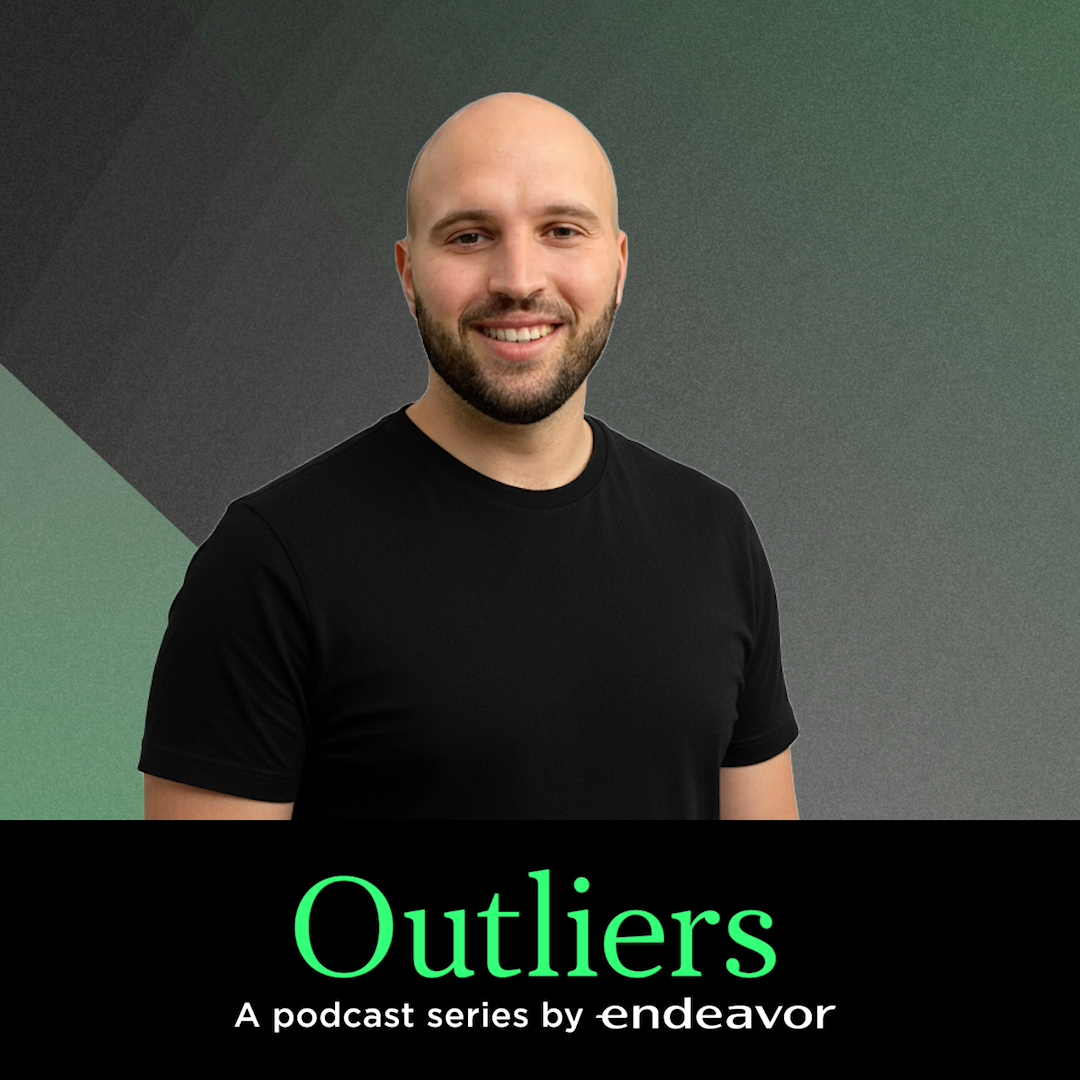
In the fifth episode of the 6th season of Outliers, we meet George Varvarelis, Co-founder and CEO of Augmenta, a deep-tech company leveraging artificial intelligence and computer vision to bring precision and efficiency to global agriculture.
Together with his co-founder, Dimitris Evangelopoulos, George founded Augmenta in 2017, transforming a university research project into a real-world technological solution for farmers. With a clear vision, strong technical expertise, and a 60-person team across Europe and the United States, they led the company to one of Greece’s most notable tech exits - its $110 million acquisition by CNH Industrial.
Today, George serves as Head of Engineering for CNH Industrial’s Global Sense and Act Division, leading multi-regional engineering teams developing cutting-edge technologies that define the future of smart farming.
Holding a Bachelor’s, Master’s, and PhD in Electrical and Computer Engineering from the University of Thessaly, and inspired by his early experiences on his family’s corn farm, George combines deep technical knowledge with genuine agricultural insight - exemplifying how Greek innovation can make a global impact.
Transcript
George: Hello, Panagiotis.
Panagiotis: Thank you very much for joining us today.
George: Thank you, same to you.
Panagiotis: A really great story for us to explore together, which is Augmenta—it’s been acquired, one of the most successful exits in the Greek tech ecosystem, and since some time has passed, I’m eager to hear what’s happened since the acquisition, what you’re thinking, what ideas you have. But before we start, would you like to tell us in a couple of sentences what Augmenta does?
George: Yes, of course. So, Augmenta provides some hardware devices for tractors, agricultural tractors. What we do is automate the largest and most profitable agricultural processes, such as the application of fertilizer, either liquid or solid, or the application of chemicals that kill weeds, for example like Roundup. So, what Augmenta’s system does is use cameras, computer vision, to assess the health of the plants, individually, each plant at a time, and we apply more or less fertilizer or chemicals to achieve the perfect ratio—exactly what the plant needs, not more and not less.
Panagiotis: And I know you’ve actually studied this as well—it’s very much connected to your childhood and where you come from.
George: That’s right.
Panagiotis: So, let’s talk about where you were born, where you grew up, and what led you to this whole journey. Where were you born?
George: Yes, I was born and raised in Volos. I come from a farming family, the most traditional, let’s say, farming family in Greece. Internally, half-jokingly, we call them weekend farmers.
Panagiotis: Okay.
George: Because we have a few fields, very few, and we don't live off them, but we used to go. I remember my entire childhood spending weekends at the fields. My mother, her whole family, comes from Ampelonas in Larissa and my father is from Nea Ionia in Volos, but basically the grandmothers came from Asia Minor.
Panagiotis: Are both parents farmers?
George: Both parents are involved in farming, but they're also public servants, meaning that's their main profession. So, that's why I tell you...
Panagiotis: Weekend farmers.
George: I had a lot of exposure to farming from a very young age.
Panagiotis: Did you help? Did you go with them, do chores as a child or later as an adult?
George: I would say I did, yes. Nothing crazy, to be honest. I started helping, it's true, more and more as I got older, meaning after 17, I remember myself becoming increasingly involved, getting engaged with farming one way or another. But of course, my major exposure to agriculture came when I met Dimitris, Augmenta's co-founder, who was a professional farmer—not a weekend farmer, but a professional—and because we were very close friends at the time, we did a lot of farm work together on his fields, which are again located in Thessaly.
Panagiotis: Were you studying together with Dimitris?
George: Right, right.
Panagiotis: You were studying at the university.
George: Right, we met in the Electrical Engineering department at the University of Thessaly. Then I did my master's, I did my PhD, and Dimitris did his master's, and that's where we connected, and almost every weekend we went to his fields, and I helped out there. In fact, I've done more agricultural work in Dimitris' fields than in my parents' fields.
Panagiotis: The question that comes to me a bit spontaneously is, how do you end up in the Electrical Engineering department at the University of Thessaly, coming from those childhood years spent with your parents in Volos and being a part-time farmer? What led you there?
George: Yeah, look, it's a bit of a crazy story, because when I talk to my mother about this topic very often, because even I can't believe it, she used to tell me that since I was five years old, I would say 'I want to become a roboticist.' Of course, I didn't know back then, in 1995-1996, there was no way we could know what robots and AI and all that, but I always had an inclination, as it seems, at least according to my mother, toward those aspects of technology: robotics, automation, etc., and as I grew up, I started to become very interested in programming too. But it happened organically, I wouldn't say there was any particular event or moment in my life that shifted my path, I mean, I always had an aptitude for mathematics, for the sciences, and that led me to the Polytechnic School of Electrical Engineering. We simply didn't have the opportunity for me to go down to Metsovio or Thessaloniki, so I stayed in Volos where we also had our family home, so that's how I ended up there, but Electrical Engineering was my first choice as a department. Ideally, I wanted Athens, of course, but I ended up staying in Volos.
Panagiotis: You stayed in Volos because it's also a bit difficult for a family to move their child to live in Athens; the expenses are enormous.
George: Especially in 2009, when the major financial crisis happened—and we experienced it, I think, like many families in Greece.
Panagiotis: And we're also lucky to have such a good spread of universities in Greece; that is, Volos has a very good Polytechnic School.
George: Correct.
Panagiotis: It's an asset for the country.
George: The university in Volos played a huge role in my journey. That is, I believe that if I had gone to Metsovio, things would have turned out differently, the story wouldn't have ended the same way.
Panagiotis: Why?
George: Because there are many factors. The main one is that the university in Volos, generally, the Department of Electrical Engineering is very software oriented compared to other universities; I mean, while Electrical Engineers nationwide are primarily engineers dealing with electrical work and there are different tracks, the Volos department is known almost exclusively for its software side, which is good because that’s exactly what I wanted to pursue. And it was a relatively new department, so it had young professors, and life brought me very close to one specific professor, Christos Antonopoulos, who was my supervisor for my Bachelor, Master, and PhD, and then joined Augmenta as well. So, one professor played a huge role in my path and in making that switch, that change from academia—writing papers—to starting a company.
Panagiotis: During your undergraduate studies in electrical engineering at the University of Thessaly, you met Dimitris.
George: Correct.
Panagiotis: Tell us a bit about this process, did you stay together all the way through your postgraduate studies? From the moment you met until today, it seems there must be a shared path. I’m wondering if there was any interruption, because you also spent some time abroad. Tell us a bit about this relationship.
George: Correct, correct. We have a crazy story with Dimitris. We actually met during our undergraduate studies in electrical engineering, we had a lot in common, which we discovered later. Dimitris has a somewhat sadder story; he lost his parents when he was 17, but his mom and my dad were friends, though we didn’t know it at the time. We learned all this later, when we started hanging out, when we were 18 or 19.
Panagiotis: Are you both from Volos?
George: So, we grew up in Volos. Generally, both of us, for different reasons, weren't very good students; it took us a little longer to finish university.
Panagiotis: How much?
George: It took me 7 years. Dimitris for very good reasons, me for very bad reasons. Dimitris had to survive, so he worked in the fields full-time as a farmer, and obviously you can't also be a full-time student, especially in such a demanding school, so he was delayed. That's why I say for good reasons. As for me, I was playing professional poker for a while.
Panagiotis: Oh, man.
George: Yes, yes, for about three years back then. So, we met roughly towards the end, around the fourth year of university, when we were saying, okay, we haven't passed anything, who else is from our year and hasn't passed anything, me and Dimitris, so how do we team up to somehow manage to graduate as soon as possible, as quickly as possible. So, that really brought us together right away, and after that we would spend, no exaggeration, 10-12 hours a day together, doing various things—at first only courses, then courses and thesis—and that basically continued right up until we started Augmenta in 2017.
Panagiotis: So, you get close with Dimitris, you say let's finish, let's get the degree. You start passing courses, I imagine.
George: Yes, very quickly.
Panagiotis: Sweeping?
George: Very quickly, extremely quickly, yes.
Panagiotis: And you graduate and go straight into your postgraduate studies; do you go together? Tell us a bit about that, because I think you have a path where you go a bit to Austin, a bit to MIT. What are the strategic decisions you make from the moment you decide to focus again on impact and academia?
George: Yes, I graduated a little faster than Dimitris, I think a year earlier, and so while Dimitris continued his Bachelor, I had already started my Master’s, and that’s the phase I mentioned before, where our professor said, guys, you’ve written a very good undergraduate paper, maybe you should take it further? Meaning, take it into the field, see what’s going on, how farmers see it; I was doing my Master’s at that time. And then that was a turning point for other reasons, a different thing of course, but it was a turning point for us—we took an academic prototype to the field, I won’t forget it, we did a fertilizer application with a prototype whose cables were hanging off the tractor, meaning, there’s no way you could sell that thing, don’t get me wrong, but we could make it work, so we did a fertilizer application on a field owned by a farmer friend of Dimitris—now he's mine too—Giorgos Angelis, and we saw a huge difference. First of all, at that moment we saw savings, I remember, 15-16% in fertilizer, which is a huge number, and even more importantly, after two weeks we saw two different fields—where we had done the fertilizer application, the field was a bit greener, there’s even an epic photo of it, but it was a bit more green, more vivid in color, and the other half, farmed in the traditional way, was a bit more yellowish. As soon as I saw that, I was shocked. I said, guys, I've never seen anything like this in my life, you've got something here. And that was the turning point for us, for me personally to decide I was going down to Athens, and so we signed up for Eurobank's EGG competition in 2017, and we got in—I don’t know how, because if you read that business plan, it’s unreadable, so I don’t know how they took us, probably did us a favor, but anyway, we went down to Athens as part of EGG. I specifically went to Athens; Dimitris stayed in Volos because he still had the fields. Of course, we hadn't raised any funding, we had no money, nothing, so we had to somehow turn this thing into a company. I used all the resources of EGG, and one of those, as you mentioned, was a trip to MIT. I remember it was the winter of 2017, almost 2018, and that was the mental turning point for us—there I realized for the first time that we were very small fish in a big pond, and that we had to change a lot if we wanted to do something global. I came back after about four months, three months, and we changed the product, the go-to-market strategy, the business model, and that’s when the company really started. And three months later, we raised our first funding round, so that’s the genesis. Behind all of this are people, individual people; specifically for the MIT trip, beyond Roula Bachtalia who ran EGG, the most important person was Marina Chatzopoulos in Boston, who we are still friends with today, and not only did she open the door to MIT for us, but I personally had the chance to have dinner with Konstantinos Daskalakis. Things I could never have imagined as a kid, a student from Volos, and that helped me mentally a lot to say, okay, we're going to dare to do something big, and okay, if it works it works, if it doesn't, it doesn't.
Panagiotis: You come back, you’re a bit fired up, you say we need to go global, we need to change, we need to get serious, our company needs to be globally scalable, so what are the things you do up to the moment when the first funding comes in—and then let’s talk about the funding?
George: Yes. Look, I’d say that throughout our journey, throughout the five years that Augmenta existed, at least individually.
Panagiotis: Five years, let's not forget that.
George: Five years. Yes.
Panagiotis: Fastest EGG...
George: Yes, yes, 2018 to 2023.
Panagiotis: An investor's paradise, this.
George: We did well. Good for the investors and for us, okay, it was good, but both I and Dimitris and the other Dimitris, the third one, and Katerina, who are the original four who started the company, all of us from the University of Thessaly, we all felt a bit like we had our backs against the wall, whether it was true or not. I mean, we'd left our jobs, Dimitris had left his fields, we had no money, so we said we have to make this work, no matter what, right? That was very important in the early days, because in six months—basically, I returned in November 2017—and within six months we'd built a company, a real company with go-to-market and product-market fit.
Panagiotis: And you've convinced everyone to quit, all four of the first team, you're all together and you've left everything behind.
George: Right. If you turn back time and ask me what was the single, the biggest reason Augmenta succeeded, I would tell you it's this. That somehow, one way or another, we convinced each other—not that I convinced them, we convinced each other—to drop everything, which is unbelievable because all four...
Panagiotis: Huge risk.
George: Yes, and all four come from farming families, strangely enough. From small villages, so we're talking about very similar backgrounds, which means it wasn't easy to say, "I'll leave the university," or "I'll quit my job."
Panagiotis: What are the things that help convince Panos Papadopoulos and Marathon, or Giorgos Tziralis to invest? What are the first wins that you as a team achieve, which sway a fund with so much experience and fantastic investors to take a bet on you?
George: At first it wasn’t easy—maybe if you ask them, they’d say it was the riskiest, the riskiest investment, of Marathon One at least.
Panagiotis: Because, to clarify and help people connect the dots, the product is hardware. This is a company that manufactures hardware, it makes a machine.
George: Right.
Panagiotis: Technology for tractors in Greece, so it has to...
George: It’s a lot of bad things together.
Panagiotis: Yes, it’s hardware, which is much more difficult to scale than software, it’s in the agricultural sector, and Greece is, yes, an agricultural country.
George: It’s very small.
Panagiotis: Extremely small, so the reasons not to invest in you were endless.
George: Correct, correct, there really were endless reasons. I don’t think there was an investor logic of ‘I’ll invest in this company and get my money back many times over.’ I think what the guys saw—well, I can’t speak for them, but I think what convinced them was that we invited them to Volos, put them in the tractor, made them see it, experience it firsthand, and talk with some local farmers. I think that was the turning point for them. And to be honest, I think it was a big bet for them. There wasn’t much logic behind the decision, but yes, we owe a lot to those guys. As soon as we started the company—the company was started in November 2017—in April 2018, four months later, we received our first funding from Marathon.
Panagiotis: Everything moved at lightning speed, which is very impressive.
George: Right.
Panagiotis: And here I want us to shift to the other part of the story, which is the actual technology and the construction of your product and solution. Tell us a bit about the problem and the solution you designed, and how you managed to scale so quickly on the manufacturing side?
George: Yes. The problem is huge, massive, global, and it’s existed for 50 years. What happens in agriculture, anywhere on the planet—maybe except for greenhouses—but everywhere else, farmers overfertilize and overspray chemicals, because that’s the safest way to ensure a good yield, since it’s more advantageous to use a bit more chemicals than risk having a much smaller harvest. So that leads them to overfertilize and overspray. So, this is a huge, well-known problem. When we started in 2016, there was a big trend—you might remember it too—with drones; that was when we had just begun, drones and satellites. So, there was a big wave of drones mapping fields, generating some maps for tractors, and then the tractors could apply certain actions based on those maps. What we knew, from the inside—especially Dimitris, but myself as well, since we've spent hundreds of thousands of hours driving tractors—was that agricultural reality is not something you can plan a week in advance, which is what drones and satellites required. It's a living process. What do farmers do? They check the weather forecast daily, and one day before it rains, they go and spread fertilizer so that when the rain comes, it dissolves it, and so on. You can't plan these things in advance, so that's where drones failed. So, what did we do? We took this fundamental technology that used cameras, just like drones do, and put it directly on tractors to operate in real time, because we believed—correctly as it turned out—that this one-week gap, which was the norm, is not good enough for global scalability. So, we put everything on the tractor: hardware, all working seamlessly, and the farmer essentially kept doing exactly what they did before, except now there was a camera system on the tractor. We didn't change their daily routine at all.
Panagiotis: Describe to us a bit what exactly this system does and how it's connected to the research you did at the university, because I think it’s a logical continuation—there’s definitely a direct link from the work you did with your professor at university.
George: Exactly, there’s a complete logical continuation. We always say we essentially started the company in 2018, but there was work behind it—at least three years of academic work that was nonetheless very important. What we did, and the innovation, was that we used multispectral cameras—so not just RGB cameras, the kind that see what the human eye sees, like on our phones, but also in the near-infrared light, specifically infrared. At these wavelengths, we can determine if the plant is stressed or not. How do we do this? Physics tells us that we look at the level of photosynthesis occurring, depending on how much light is reflected back to the camera, especially in the near-infrared. This shows us how stressed the plant is. If it’s very stressed—more yellowish, to put it simply for people listening—it means it needs more, say, fertilizer. Conversely, if it’s very green and has reached its peak growth, it doesn’t need as much. And there are other cases, for example, when there’s no plant at all or the plant has died. In those cases, you don't need to apply anything because it would be wasted. So that’s the basic logic. This principle existed already in drones, as I mentioned, but our innovation was to make it real time.
Panagiotis: You put it on the tractor, so the measurements happen exactly as the tractor passes through the field.
George: Exactly. Which brings a lot of technical difficulties. The biggest one is the different conditions in various fields, depending on the sun, clouds, absence of clouds, or mountains. The sun can be right in front of the camera, so there are lots of challenges, which is also why no one else had managed to do it until then.
Panagiotis: So, your competitive advantage is that you’ve put a lot of work into making this solution operate in real time and compatible regardless of external conditions.
George: Exactly.
Panagiotis: What challenges did transferring this technology to the tractor bring? Because I imagine that, by itself, is quite a journey.
George: We did a retrofit, which was very important, and Alex—Alexandros Nikolakakis—played a huge role in the story. He was the fifth member of our group; we met on the same trip I took to Boston. Alex was the CEO of a company called Muse Robotics at the time, funded by Qualcomm, based in California. We met, and he really believed in both the idea and the team, so he came on as the CTO of the company. He had much more experience than us—he had 10 more years in hardware, proper hardware. Not only did he join us, but he also brought a big part of Muse with him to Augmenta, so it’s like we kind of cheated, because we brought in a very experienced hardware team to help us with our first steps. If we had been on our own, we would have had huge hardware problems—not that it’s easy even with a team—but if you’re asking how we managed to very quickly build something that could actually be installed and was installed, that’s the reason.
Panagiotis: How hard was that decision? Because it really strikes me as a big move. It sounds a bit like an acqui-hire...
George: Without money.
Panagiotis: Without money. Were they from America? Did they come to Greece, these guys? So, they repatriated and they’re all Greek?
George: Yes, they’re all Greek.
Panagiotis: All Greeks, you repatriated them back to the country. What’s the process for making this kind of decision? Because it’s a big decision.
George: I think I used the same techniques I’d used with the other three guys in the team, early on. I believed in it a lot—really a lot—the market was huge, and it was the right moment. I think the guys understood that. Maybe the guys who came from California—Alex, Pavlos, and Kostas back then—maybe they got it even more than I did, because they were in America, already much more exposed to entrepreneurship than I was, so maybe they saw it even more than I did. But I think that was the reason—they saw the opportunity. We didn’t have salaries back then, we had stock options, and I think that’s what ultimately brought them back.
Panagiotis: Tell us a bit about the stock options plan, because I think it’s really important for prospective founders to hear about.
George: For me, as the CEO of Augmenta, it might be the most important part of a company, especially early on. Our stock options plan was huge—we had 25%, which is well above average. We knew we had to be very generous with the stock options plan, because that’s what would allow the company to reach new horizons. And we did it very early—essentially from day zero.
Panagiotis: You have raised 600,000 euros from Marathon.
George: 500,000. 600,000 dollars, yes.
Panagiotis: 600,000 dollars. 500,000 euros from Marathon, and now the difficult game begins. The money's in, you've brought in investors, so now there are more people in the company, and the pressure for growth is much, much higher. What are the steps that need to be followed until the next round that bring the successes you need?
George: Let me tell you, as soon as we closed the round—not when we got the money, but as soon as we closed the round—I booked a ticket for Austin, Texas, where I would relocate. The round was announced a week later, but I had already left. For me, it was a one-way street.
Panagiotis: Why Austin?
George: The reason was that I knew Texas, of course, is huge—a big state for agriculture, especially cotton, corn, and wheat, which were also the crops we were working with. It's massive. That was the first reason. But I looked at the map and saw that Austin was close to farmland—from the map—and that was enough for me to say I would go to Austin because it was also the capital and so on, up-and-coming at the time. So, I went to Austin for the first time, and after a week, I had arranged to meet a professor at College Station, which is one of the biggest agricultural universities in Texas, and I thought, okay, I’ll just take the bus to go there.
Panagiotis: To Dallas? Where was it?
George: And it was four hours away, but on the map, it looked like, say, Volos to Larisa. So, what I mean is, I had a completely different perspective on distances before I went and thought that Austin was right next to the fields, like Volos is right next to Perivlepto, for example.
Panagiotis: The scale is different.
George: Yes, things are a bit different. But that was the naive, bad reason I started, but later I stayed...
Panagiotis: You're also lucky, of course, because you've landed in a city that has gradually begun to become one of the technology epicenters of the United States and definitely a major hub for manufacturing. For industry. Now Tesla is based there, there are very large American automotive companies, you have South by Southwest there, it's truly an epicenter.
George: Correct.
Panagiotis: Did Austin play a role, even though it was a random choice?
George: Austin did play a role. In Austin, I met our Seed Round investor, Emeric, who was San Francisco-based—I just met him in Austin. Afterwards, of course, I went to San Francisco for a while too, where he was the GP of Hardware Club, a very large seed...
Panagiotis: Of course, seed...
George: Stage VC. So, Austin definitely played a role, it was a hub for entrepreneurship—not quite like San Francisco, especially in 2018; now it's much stronger than it was back then. It certainly played a role for me on a personal level, so I could meet other founders, learn a bit more about how you can scale up certain things, so for sure it played a role. And okay, I may have been four hours away from the fields, but it was only four and not fourteen, so I would take the car and go, meet farmers, whether they were in Texas, Oklahoma, Kansas, etc. So, Austin—and Texas in general—definitely played a part in the journey.
Panagiotis: Are your first customers coming from America because of this relocation?
George: Correct.
Panagiotis: So, the first customers are from America.
George: Correct.
Panagiotis: What is it like working with these people? How did they help in your later success and even in transforming your product's technology?
George: Even though Augmenta did not sell to farmers, Augmenta sold to dealers, like how cars are sold, the relationship with the end customer is extremely important and it's easy to neglect it, because it's easy to focus on the customer who pays you and neglect the end user. This can make you drift away from good user experience. Of course, Greek farmers and American farmers are not at all alike, and this was very important, it played a big role in our journey, because not only Greece but also Europe, the fields are much smaller, the tractors are much smaller, the flow of agricultural processes is very different, whether we're talking about Greece, Germany, Poland, America, Brazil, or, let's say, Canada. So, without that exposure, boots on the ground—not just a weekend visit, but every day—it played a huge role in helping us build something that is as general as it needs to be to be scalable.
Panagiotis: What are the next steps? You’re raising a Series A round from an American...
George: Hardware Club.
Panagiotis: Hardware Club, a very strong venture capital fund.
George: Right, 2.5 million was our seed round.
Panagiotis: Which, you know, is also a very big win because convincing an American investor, especially one with focus and expertise in hardware, is no small feat.
George: Correct.
Panagiotis: For them to take a bet on you was, I think, a day that changed your trajectory and was one of those pivotal moments, I imagine. One of the turning points. What are the next things you've identified as milestones in this journey? And when does the acquirer come in? Because the company you agreed to be acquired by, CNH, comes in as a client at first, right? They come in as a client and strategic investor. So, a relationship is built with them and I think it's interesting for prospective founders to know about this path.
George: Yes, so in 2019 we raised our seed round. That is, one and a half years after the first round, at the end of 2019, in a Silicon Valley fashion the round was closed in a café, coffee shop in San Francisco with Emeric, and to give you an idea, at that time we still had 80% clients in Europe.
Panagiotis: Ok.
George: In 2019, around 80%, maybe even more.
Panagiotis: Even though you were in America.
George: Even though I was in America.
Panagiotis: Who was selling in Europe? Dimitris.
George: Dimitris a lot, he travels all over Europe, we had many clients in the Balkans, Ukraine back then, that changed a bit with the war, but we had lots of clients in Germany, Netherlands, the Balkans, and Ukraine. So it was 80-20 Europe-America at the time, but we used those 2.5 million from 2019 to 2021 to scale the team a little—we were about 6 people in 2019 and grew to around 14-15, which was very important for us, because that's when we also built the web platform I told you about earlier, so that there could be a more circular experience for the client. So, for those two years, it was purely grinding for us: clients, second generation hardware.
Panagiotis: Feedback?
George: Exactly, feedback, continuous changes every quarter, everything switched up, let's say. Very normal startup story. And that brings us to 2021, when we're at a trade show in Germany, where I meet the CNH M&A department, and that's how the first contact happens, though the first contact wasn’t investment-related, it was commercial interest, so we did a first, let's say, prototype R&D kind of contract.
Panagiotis: Tell us a bit about CNH. Explain to us what it does, its size, so we understand—and you know, because it’s the organization that totally changed Augmenta’s path, right? Let's understand what kind of organization we're talking about.
George: Yes. So, CNH is the second largest tractor manufacturer in the world, just behind John Deere, though quite a bit smaller than John Deere, with a market cap of around 20 billion—it was a little higher some years ago. Now, there’s a big downsizing in agriculture, across the board, globally, so: tractor manufacturer, iron company, industrial, heavy industry, and behind it is the Agnelli family through Exor, so CNH is one of the biggest agriculture players globally.
Panagiotis: And it works with the machine and vehicle you want to access—that is, a tractor manufacturer. I can imagine it’s your top destination, because this organization can get you into all the tractors. Literally every tractor.
George: Right, and that's exactly why we really wanted to collaborate with them.
Panagiotis: They're also investing in the next round. I'd like you to tell us a bit about that and how it was part of your strategy to bring them in—was it in your mind from the start that you wanted them to acquire you, or did it come up later?
George: We weren’t aiming for an acquisition, not even when it happened. I mean, obviously when it happened, we took the term sheet, started talking about it, but there was no discussion with the team about any kind of exit. When CNH entered Augmenta in 2021, there was, of course, a huge strategic benefit—for the reason you mentioned before, that they opened up a huge sales network.
Panagiotis: Which also provides insights,
George: Yes, insights, which is almost impossible to build on your own in this industry, no matter how much money you have.
Panagiotis: 100%.
George: So, CNH is a 180-year-old company, so I want to say that this was a major part of why we wanted them to come in. They also gave us a very good valuation at the Series A, which played a role for us, because if you ask me, maybe the rule should be not to have an industrial or potential acquirer come in before Series B, because that can create issues in future acquisitions, in terms of competition.
Panagiotis: And in commercial development.
George: Right, if there are exclusivities and so on. We fought very hard, it was a big battle both personally and as a team back in 2021, to not have exclusivities on any side, neither commercial nor investment-wise. Of course, despite that, the industry's perception when you take money from a potential acquirer is that you’re their child.
Panagiotis: Of course. They wouldn’t ask.
George: They wouldn’t ask, exactly. They’ll assume there’s exclusivity, or they won’t open up because they consider that you have a board member from a competitor, so there are negatives in bringing one in.
Panagiotis: Dilemmas with a strategic investor.
George: Right, right.
Panagiotis: Dilemmas. And you put it very well—I think it’s worth repeating—that maybe the moment a company can respond more dynamically to these dilemmas is after Series B.
George: Right.
Panagiotis: Not early on, with a strategic investor.
George: Right, right. It’s just that, for the reasons we mentioned earlier—hardware, agriculture, the valuations—we wanted a good Series A where we raised 8 million at Series A, and we wanted it to be high. So, they gave us a very good valuation compared to some other offers we had on the table, and that was enough to push us over. Over to the other side, so to speak.
Panagiotis: When do acquisition discussions begin and how do they evolve? How does someone start such a conversation?
George: I can tell you now from personal experience, it was quite a lonely journey; imagine that I was by myself, I was in Austin, and the rest of the team, especially the founding team with whom I could discuss these matters in detail, was in Greece. The discussions about the actual acquisition didn’t start until about a week before we received the first term sheet. The discussions at that time were about us raising a very large Series B, 45 million Series B; that was the plan A, the public plan A both for the outside world who didn’t know the internal details and for CNH as well. So, the board—this was the plan they knew, and with this perspective I went to ask CNH whether they would participate, if they’d take their prorata. Their prorata or if they wanted to put in more, etc. So that’s how the conversation started, very organically, and at the time they told us, of course we’ll participate in the prorata, very relaxed.
Panagiotis: Prorata, to clarify for everyone, is when an investor who participated in a previous funding round has secured the right to join the next round with a specific percentage. So, when you start to raise your next funding round, after 6, 10, 12, 20 months, whenever someone is looking for their next investors, the first thing they do is go to those who are already their investors and say: you have the right to participate with this much. Will you take it or will you release it so I can look for others? So, that’s how you went to CNH to ask if they’d join. In the 45-50 million round you were raising for Series B.
George: Right, I went to Chicago then, that was the first contact. They are very good, CNH’s M&A department is extremely good; Michele Lombardi, who still leads it today, is one of the best worldwide at this job. He’s done countless deals, so he didn’t give me any hint that there was anything else on the table, or that they were considering or discussing anything internally, so as far as I was concerned, there was no such scenario. So, I was following the fundraising process for Series B as usual, and we had a few ups and downs, because in 2022 there was the big crash after COVID, especially with private equity firms—which were our main targets for the Series B of 40-50 million. Private equity was mainly our target, so they were in the mode of “we keep for reserves,” meaning they would hold on to money to invest in companies they had already invested in. So, we went through a bit of a slump there and I started to get a little worried. In the end, with a lot of effort and grind, we got some term sheets on the table, not perfect in terms of valuation, but definitely good enough to have a plan B. So, I think that mattered a lot, because M&A, and Michele in particular and Francesca at the time, saw that I was ready to make a move, and that’s when they sent us the first term sheet.
Panagiotis: What helped you in this negotiation?
George: It was a very tough experience for me, because the initial offer was not even one third of the final offer we received. And most importantly, I was there alone in Texas and I didn’t tell anyone anything, not even the Board at the time. Well, I shouldn’t have told them right away anyway, but I didn’t even tell the team. I didn’t want any distractions; I wanted to be in a do-or-die mindset, as if my back was against the wall, that no, we’re not taking the first offer you sent us, even though since, as you said, it was a wild offer, we could never have imagined even one third of it, nor that we’d ever achieve such success.
Panagiotis: And you’re saying you didn’t want to have any pressure from...
George: Not at all, yes.
Panagiotis: From someone with a different mentality than yours who would tell you, just take it, take it and get it over with.
George: Not necessarily, that number was huge. So, for all of us it was huge, so it’s very logical to think, yes, take it because it might not happen again.
Panagiotis: Yes, I might not get another.
George: Meaning, you play hardball, act tough, and then you lose even what you have. So, that was the logic, and to be fair, the rest of the team’s role wasn’t this. It was my job. The rest of the team’s role was mainly the product, so I couldn’t expect that they’d see that this could go 3X, for example. So, I didn’t want there to be such friction within the team, and I won’t hide that I also felt at the time that this might not go anywhere. So, we shouldn’t distract ourselves from the product. I mean, we had customers at the time, hundreds of customers in fields worldwide, doing very serious work for them, and we couldn’t all be thinking about an M&A that might never happen. So, I handled it a bit on my own, especially in the beginning, and the truth is that the plan and strategy I had in mind actually worked. Meaning, I went in very tough, with hard negotiations, to get across the message that I wouldn’t accept anything but, let’s say, X amount. And in the end, that raised the initial offer quite a bit.
Panagiotis: How did you decide on that amount? And what support did you have? Did you have mentors, people to use as a sounding board, people who helped you get some feedback here, or did you go with your intuition?
George: It was a bit tough because you asked about the amount; the amount was very difficult because we had a crazy multiple of revenues in the final amount we got. We had relatively few sales globally, so I think it was all about the story, there was no mathematical explanation why 120 versus 50. So, there wasn’t any logic there. So, what does that mean? That I had to try to connect Augmenta’s vision and mission with what CNH wanted to do. And to try to sell them the story—which, in the end, was true, it wasn’t just ...
Panagiotis: Yes, yes, it's not a lie.
George: It's true, exactly; it's about how they're going to make money and, based on that conversation, we talk about valuation. Instead of taking it backwards—how much revenue do you have, so I give you this multiple, etc.—that's how I thought about it and structured it in terms of storytelling.
Panagiotis: Especially a Series A company that's going to raise a Series B, will mainly sell what we can create together and the value of what we'll create in the future.
George: Right.
Panagiotis: Why should we look at revenues now? It's unfair to the technology, since it's not implemented yet. It hasn't spread out into the world.
George: Right, right.
Panagiotis: We end up with an agreement. This agreement is public, 110 million, a fantastic amount, an incredible success for a 5-year-old company. How do you announce it to the team? What impact does it have? What does it mean afterwards?
George: Yes. How do you announce it to the team? Well, it was one of those cold calls, let's say. And I told them—well, the guys knew basically at the penultimate iteration I told them, meaning when we reached an amount, I felt comfortable with, then I updated the team on where we were in the process.
Panagiotis: You make a call, you join a call with people on it, where you're announcing to them that they're going to become millionaires.
George: Right. But no one—even now we joke about these things—because no one did the math. No one. Not even then. Like, we just talked about amounts.
Panagiotis: Yes, and you just didn't grasp your own part.
George: And no one really understood what that meant for me. And they didn’t do it either, because that was a characteristic of the original team, especially since they were still in privy mode for these things—they had incredible focus. I’ll never forget that when I first mentioned these discussions, they replied, 'Yes, okay, but we have customers who are operating right now, and we can’t leave those customers because you never know what might happen.' So, they had insane focus on…
Panagiotis: Execution, execution…
George: Yes, on the day-to-day, and of course, trust in me, like 'Okay, George will solve whatever issue comes up and we’ll stay focused on the customers.'
Panagiotis: Dream come true, right?
George: It’s a dream. It’s incredible. That’s why with this team we could do… We’re extremely close. We’ve lived together. It’s amazing.
Panagiotis: It’s also, I think, a testament to who you are as founders and who you are as people. Teams are a reflection of the people who build them. Has your role and the team’s role at CNH evolved today? Are you still there? Tell us a bit about that.
George: Yes, most of the team is still at CNH. My own personal role has evolved a lot since what it was in 2023. I’m leading a very large organization, one of the biggest at CNH engineering, and I’m responsible for anything that has cameras and gets installed on tractors—which covers lots of products, from simple to more complex, like Augmenta’s. Also, a big part of my time goes to M&A, whether that’s minority investments, like Augmenta once was, or full acquisitions. That means I do technical due diligence and human resources due diligence for companies.
Panagiotis: You must love your job.
George: It’s extremely inspiring, mainly because we can see the impact.
Panagiotis: The impact precisely… You’re at the epicenter of impact; you can now scale and expand other people’s solutions. Right. And of course, your own; the Augmenta solution since the acquisition, its presence in Greece and its impact in Greece—has that grown and how?
George: It’s grown a lot. I had two main goals when the acquisition happened. One was what you asked, integrating Augmenta’s system, hardware and software, as factory fit, as they say, into CNH’s tractors. Straight from the factory. Just like when you get a car and specify a color or a gadget, you’ll be able to buy a tractor and say, 'I also want Augmenta.' What does that mean? Apart from astronomical sales growth, it’s an integrated solution. It won’t look like an aftermarket; it won’t look like an add-on system. That was a big personal goal for me.
Panagiotis: Has it been achieved?
George: It just got achieved. It took us a bit because that’s normal—there are so many factories, it’s massive scale—but we just announced that from now on, farmers worldwide can select the Augmenta solution as…
Panagiotis: Let me sum it up visually for you: What you’re saying is that from now on, all over the world… Globally. The world’s number two tractor manufacturer—correct?—will give farmers everywhere the option to select, to pre-select your solution, your cameras, and your software in the initial tractor itself. Embedded.
George: Correct.
Panagiotis: So, this is global scalability for a Greek technology.
George: Correct. To give you numbers—from 300 or 400 farmers a year, 400 systems, we’re talking about 10,000, year one.
Panagiotis: Who do you think will be impacted by this success? I mean for Greece.
George: We believe, first and foremost, that Greece is the right ecosystem for such technologies. OK, the fields in Greece are small, but we still have a primary sector, we have motivated farmers, which means it might not be the first commercial market globally, but that’s fine. As long as there are motivated engineers, engineers from farming families—so they have extra reasons to work on this—and as long as there are fields nearby, just one or two hours away for pilots, we believe it’s the right country to establish large CNH divisions and to create even better technologies in the future, beyond Augmenta, and instead of 10,000, get to 100,000 tractors.
Panagiotis: So, do you believe that the footprint, the impact, and CNH’s presence in Greece—including the investment, the facilities, and especially the people it employs—correct? Do you think that after this success it will grow, or will everything move to Austin, or to Kansas, where CNH’s R&D headquarters are?
George: No, the opposite. The office has already grown by 30%.
Panagiotis: Thirty percent since the acquisition.
George: Right. And it will keep growing. I’m seeing this now from the inside, but it’s CNH's strategy—as it is for many major American companies—to look a bit outside America. Mainly for what we mentioned at the start about the skill level of engineers and, of course, the cost, right? That’s an extremely strong advantage in Greece. So, I have very high ambition for what’s coming.
Panagiotis: As an organization, we’re really passionate about the multiplier impact. We measure it, and in the coming years we’ll even try to make it a global metric by which to gauge a founder’s success.
George: Yes.
Panagiotis: How many other founders did a founder help create after their own success, or alongside their success. And I wonder, looking at you and your founding team, and those who became millionaires and comfortable after this success, do you see investments, mentoring, is there a multiplier impact? And how do you feel about it?
George: It’s massive, from what I see and know. I don’t want to speak for the others, but I can share two or three things. First, almost all of us have invested in startups as angel investors with a passive role. As investors, but you know how it goes—it’s never truly passive, you always end up helping in one way or another.
Panagiotis: Absolutely.
George: Personally, I’ve made 11 investments, which is a lot for the timeframe; Dimitris has invested in several companies as well. We’ve invested in funds, so one way or another, money is flowing back into the ecosystem, whether directly or more indirectly. Dimitris Akridas, the other Dimitris—the third in the company—has supported another Agtec company called Index from Volos, the guys doing IoT. That technology is used in breweries. So, what I mean is, almost all of us are pretty involved in the ecosystem in one way or another, and we really believe in it.
Panagiotis: Shall we play a fun game?
George: With great pleasure.
Panagiotis: So, these are cards, each with a word. A word in strategy, and we want your definition.
George: Okay.
Panagiotis: Let’s see where this takes us.
George: Collaboration, cooperation.
Panagiotis: Perfect.
George: That’s a necessity for a company, especially first-time founders—I believe partnerships need to be built early and must be based on intent. For us, collaborations—whether with universities, professors, or angels who never put in money but contributed their networks and effort without asking for anything in return—were pivotal for Augmenta’s future. So, without collaboration, I don’t think success is possible.
Panagiotis: Let’s play a fast-question game to catch things we might not know about you.
George: Absolutely.
Panagiotis: Quick questions. Are you into books or podcasts?
George: Audiobooks. In the middle.
Panagiotis: Wonderful. Are you a morning or night person?
George: I was a night owl until two years ago, now I’m a morning person.
Panagiotis: Coffee or tea?
George: Coffee.
Panagiotis: Coffee. If you could have dinner with any historical figure, who would you choose?
George: I’ll tell you—it’s not a historical figure. Not in the traditional sense. The person I wanted to dine with—and did—was Konstantinos Daskalakis.
Panagiotis: Okay.
George: Even from a young age—16 or 17, when I could understand these things—I always saw him as the peak of our science, and I managed to have dinner with him through Marina, which was amazing for me. Apart from that—which I did—I’d say I’m not much into history; I’m more into the present; I’d have liked to meet Elon Musk before 2021. After ‘21- ‘22, some things changed, but before ‘21,
Panagiotis: After 2025 you’ll see how much things change; fewer people will put him on their lists, but I get it.
George: I consider him a fantastic entrepreneur and I’d like to get inside his head, see how he thinks, how he thinks in first principles and so on.
Panagiotis: A kind of technology you couldn’t live without?
George: It’s the mobile phone, unfortunately, yes, shame but it’s true.
Panagiotis: It’s almost a redundant question now.
George: ChatGPT will become that.
Panagiotis: What’s your favorite city for business trips?
George: San Francisco.
Panagiotis: San Francisco is a fantastic city. Is there a book that ranks very high on your audiobook lists?
George: Yes—the book that played a huge role in my own journey and with Augmenta was Venture Deals. The subtitle is 'Be smarter than your lawyer and your venture capitalist.'
Panagiotis: It helped you a lot?
George: Yes, because I didn’t know—especially at the Pre-seed/Seed stage—I really didn’t know, so it helped me tremendously. And then another book that helped me build a team was The Five Dysfunctions of a Team.
Panagiotis: What is the best advice you’ve ever received, or one that stands out?
George: 'Hire fast and fire faster.' They told us that at MIT—we did a role-playing exercise on it—and at first, I thought, especially when you have a startup and are just starting out, firing isn’t something that happens often or should happen. But I realized as we scaled up those things you see early on—culturally, bad fits...
Panagiotis: They never change.
George: They’ll always come back to bite in a year or two; they never change, as you say. Now, with experience, I do it, and I think it’s one of the most important things.
Panagiotis: It’s hard though—letting people go is tough.
George: Extremely tough, especially in startups.
Panagiotis: If you weren’t doing what you do now, as a founder and now at CNH, what do you think you’d be doing?
George: Robotics.
Panagiotis: Robotics. One last question—we’ve asked this consistently for four years at the end of our episodes: What do you think makes an entrepreneur an outlier?
George: I’m a bit biased—I think it’s the chip on our shoulder, chip on our shoulder. I’ll tie it to what I said before about the team; I think there needs to be something higher, some higher purpose, whether it’s an experience you had as a kid with a specific sector, or you’ve literally worked in a sector your whole life and you live and breathe what you are trying to do, or you’re an immigrant in a country and that’s your only way out, the only way to succeed. I think in one way or another, you need to have struggled a lot to become an outlier. Not that there aren’t exceptions, but I see this working consistently—at the founder level, first employees, key employees...
Panagiotis: Someone pressured to change the context completely.
George: Correct. There’s something in life that pushes you. It can be lots of things. It could be a bad or good family situation. What does bad mean? Maybe no money. Good? That all your siblings, your parents, are very successful, so you have to be successful too. So, there are certain components, family, social, or whatever, that drive you, that give you that extra push. I think that’s extremely important.
Panagiotis: George, thank you so much.
George: Thank you.


